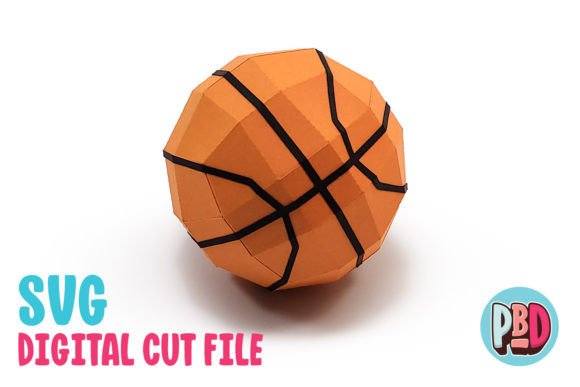
Strategic Design: Leveraging Basketball 3D Papercraft for Tangible Branding and Decor
In an era dominated by digital saturation, the strategic value of tangible, physical artifacts has never been higher. Whether you are a small business owner looking to enhance your retail environment, an educator seeking engaging teaching tools, or a creative professional aiming to elevate event aesthetics, the Basketball 3D Papercraft offers a unique intersection of utility and artistry. This is not merely a craft project; it is a deliberate design choice that can influence atmosphere, communicate brand identity, and foster engagement in ways that flat imagery cannot.
The specific design in question—a compact, geometric sphere measuring 3.5 inches in width, depth, and height—represents a calculated approach to spatial decoration. Its dimensions make it versatile enough for desktop displays, shelving units, or clustered installations without overwhelming the viewer. When executed on medium cardstock as intended, the resulting object possesses a structural integrity and visual weight that commands attention. Understanding how to deploy this asset effectively requires moving beyond the simple act of assembly and considering the broader implications of its presence in your personal or professional space.
Defining the Asset: More Than Just a Model
At its core, Basketball 3D Papercraft is a low-poly representation of a classic sports icon, translated into a format that bridges digital precision with manual creation. The inclusion of SVG and DXF cut files alongside PDF instructions signifies a workflow designed for modern creators who utilize tools like Silhouette Studio or Cricut Design Space. However, the strategic utility lies in the final output. Unlike mass-produced plastic replicas, a papercraft model carries the nuance of human effort and customization.
For marketers and brand managers, this distinction is critical. In a world where consumers are increasingly skeptical of polished, impersonal advertising, objects that show evidence of curation and craftsmanship build trust. Placing a hand-assembled basketball model in a client meeting room or a pop-up shop signals attention to detail. It suggests that the entity behind the decor values quality and is willing to invest time in the finer points of presentation. This subtle psychological cue can enhance perceived value and strengthen brand positioning.
Strategic Applications Across Industries
The decision to integrate Basketball 3D Papercraft into your environment should be driven by specific goals. Random decoration rarely yields significant returns; intentional design does. Below are several contexts where this asset serves a functional purpose beyond mere aesthetics.
- Retail and Hospitality Ambiance: For sports bars, athletic apparel stores, or gym lobbies, thematic consistency is key to customer experience. A cluster of these 3.5-inch models suspended at varying heights or arranged in a dynamic display case creates depth and texture that posters cannot achieve. The geometric facets catch light differently than smooth surfaces, adding visual interest to the space.
- Educational Engagement: Educators can utilize the assembly process itself as a lesson in geometry, spatial reasoning, and following technical instructions. The transition from a flat DXF or SVG file to a three-dimensional object provides a concrete example of dimensional transformation, making abstract mathematical concepts accessible to students.
- Event Marketing and Giveaways: For entrepreneurs hosting launch parties or community events, these models serve as memorable, low-cost giveaways. Because they require assembly (or can be pre-assembled as a demonstration of care), they stand out against the sea of generic pens and stickers. They act as conversation starters, extending the lifespan of your brand interaction long after the event concludes.
- Home Office and Personal Branding: For freelancers and content creators working from home, background aesthetics matter during video calls. A well-placed Basketball 3D Papercraft on a bookshelf adds a touch of personality and hints at interests or niche expertise without cluttering the frame. It humanizes the professional setting.
Technical Execution as a Quality Control Measure
The quality of the final product directly impacts its strategic effectiveness. A sloppy assembly undermines the intended message of precision and care. Therefore, approaching the technical requirements with diligence is part of the overall strategy. The design specifies medium cardstock, a material choice that balances flexibility for folding with the rigidity needed to hold the 3.5-inch cubic form. Deviating from this specification—using paper that is too thin or cardboard that is too thick—can compromise the structural integrity and visual appeal.
Furthermore, the file formats provided (SVG and DXF) cater to different levels of software capability, but they demand correct handling to ensure clean cuts. Users of Silhouette Studio, particularly those on the Basic Edition relying on DXF files, must adhere to specific preference settings. Changing the import setting from "As-is" to "Centered" is not just a technical hurdle; it is a quality control step. Failure to do so results in misaligned cuts, which leads to assembly frustration and a flawed final product. Similarly, prioritizing SVG files for users with Designer Edition or Cricut access ensures cleaner paths and faster processing times. This attention to technical detail mirrors the attention required in business operations: skipping steps to save time often results in costly rework later.
Planning Your Deployment
Before committing resources to producing multiple units, a pilot approach is advisable. Assemble a single unit to test the material behavior and the time investment required. This allows you to calculate the true cost per unit, factoring in labor hours if you plan to sell them or have a team assemble them for an event.
Consider the scale of your deployment. A single model acts as an accent; a collection acts as an installation. If your goal is to create a impactful visual statement, planning the arrangement is as important as the build itself. Will they be monochromatic to match a brand palette? Will they use traditional orange and black for immediate recognition? These color decisions should align with your broader visual identity guidelines.
Risks of Contextless Implementation
While the Basketball 3D Papercraft is a versatile tool, it is not a universal solution. Deploying it without a clear strategic context can lead to mixed messages or wasted resources. For instance, placing a sports-themed papercraft in a formal legal office or a somber healthcare waiting room may create cognitive dissonance, confusing clients rather than comforting them. Relevance is paramount.
Additionally, underestimating the labor involved can strain operational efficiency. If you intend to produce these in bulk for a large-scale campaign, the manual assembly time can become a bottleneck. Without a streamlined production line or clear delegation of tasks, the project can divert focus from core business activities. It is essential to weigh the aesthetic benefit against the opportunity cost of the time spent.
There is also the risk of poor execution due to inadequate preparation. As noted in the technical specifications, file compatibility and machine settings are crucial. Ignoring these details leads to wasted materials and a perception of amateurism. In a professional context, a poorly cut or glued model reflects negatively on the brand's commitment to quality. Therefore, ensuring that the person responsible for the production understands the nuances of the software and material is a non-negotiable prerequisite.
Making the Decision: Is This Right for You?
Ultimately, the decision to utilize Basketball 3D Papercraft should rest on a clear assessment of your objectives. Ask yourself: Does this object support the narrative I am trying to tell? Does it enhance the experience of my audience, whether they are customers, students, or guests? If the answer is yes, then the investment in time and materials is justified.
This design offers a rare opportunity to merge digital efficiency with analog charm. By leveraging the included SVG and DXF files correctly, selecting the appropriate medium cardstock, and adhering to precise assembly techniques, you transform a simple download into a strategic asset. Whether used to decorate a bedroom, energize a party, or reinforce a brand's identity in a commercial space, the value lies in the intentionality behind its use. Approach it not as a hobbyist pastime, but as a calculated element of your broader design and communication strategy.
Remember, the most effective designs are those that serve a purpose beyond their existence. When you place a Basketball 3D Papercraft in your environment, ensure it is there to work for you—communicating passion, precision, and a thoughtful approach to the details that matter.