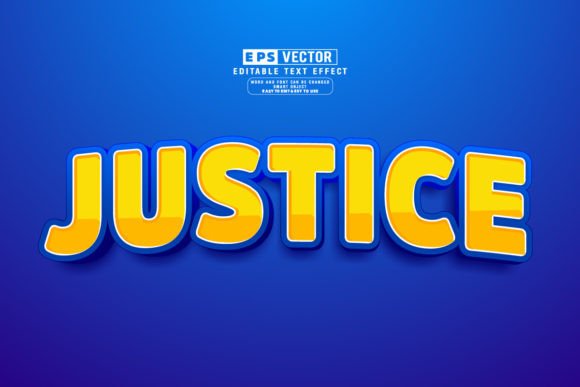
Mastering the Justice 3d Editable Text Effect Vector for Professional Designs
Creating bold, impactful typography often feels like a steep mountain to climb for designers who aren't deeply versed in advanced 3D modeling software. You want your headlines to pop, perhaps for a legal firm's brochure, a motivational poster, or a high-stakes marketing campaign, but the technical barrier to entry can be frustratingly high. This is exactly where a resource like the Justice 3d Editable Text Effect Vector becomes an invaluable asset. It bridges the gap between amateur experimentation and professional polish, offering a streamlined path to stunning visuals without the need for hours of rendering or complex mesh manipulation.
However, simply downloading a premium asset does not guarantee a perfect result. Many creators, from seasoned freelancers to small business owners handling their own branding, fall into specific traps when integrating pre-made effects into their workflows. Understanding these pitfalls is crucial for maintaining efficiency and ensuring the final output meets professional standards.
The Misconception of "Set and Forget"
One of the most common misunderstandings surrounding editable vector effects is the belief that they require zero artistic input once applied. While the Justice 3d Editable Text Effect Vector -100 Editable package is designed for ease of use—often boasting features like "Just Click and Edit"—treating it as a magic wand can lead to generic-looking designs. When users fail to adjust the context of the effect, the result can feel disjointed from the rest of the brand identity.
For instance, a user might apply the default font included in the template directly onto a modern, minimalist website header. If the default typeface is overly ornate or heavy, it clashes with the surrounding UI elements, creating visual noise rather than hierarchy. The mistake here isn't the tool; it's the lack of customization. To avoid this, always treat the effect as a starting point. Change the fonts to match your brand guidelines immediately. Since these vectors allow words, fonts, and sizes to be changed easily, you have the freedom to swap a bulky serif for a clean sans-serif while retaining the sophisticated 3d depth and lighting.
Overlooking Scalability and Resolution
Another frequent error occurs when creators confuse raster effects with true vector graphics. In the rush to meet a deadline, a designer might export a preview image and use that instead of manipulating the actual Adobe Illustrator file. This leads to pixelation when the design is scaled up for large format printing, such as banners or trade show displays.
The core value of a Vector Design lies in its mathematical precision, allowing infinite scalability without quality loss. When you download a pack labeled as vector, ensure you are working within Adobe Illustrator and keeping the layers intact. If you flatten the image or rasterize the text layer prematurely, you lose the ability to edit the content later. Imagine needing to correct a typo on a printed billboard; if you didn't preserve the editable vector nature of the file, that minor correction becomes a costly reprint job. Always keep your master .AI files organized and un-flattened.
Ignoring Lighting and Color Context
Three-dimensional effects rely heavily on simulated lighting to create the illusion of depth. A significant oversight many beginners make is ignoring how the pre-set lighting in the Justice 3d Editable Text Effect Vector interacts with their background color. A text effect designed with bright, metallic highlights might look incredible on a dark background but vanish completely against a white or light gray backdrop.
This mismatch affects presentation and communication clarity. If your audience cannot read the headline because the contrast is poor, the design has failed its primary purpose. Before finalizing your project, test the effect against your intended background. Most high-quality vector packs allow you to adjust gradient fills and opacity settings. Take the time to tweak the shadow density and highlight brightness to ensure legibility. A practical approach is to create a duplicate of your text layer, flatten it temporarily, and run a contrast check to see if the message remains clear to the eye.
Navigating Licensing and Usage Rights
Beyond the technical aspects, there is a critical administrative step that is often overlooked: licensing. Whether you are an entrepreneur launching a new product or a blogger creating thumbnails, understanding what you can and cannot do with the asset is vital. Some "editable" packs come with restrictions on commercial use or limits on the number of end products.
Failing to read the license agreement can lead to legal complications down the road, especially if your project gains traction. Always verify if the license covers client work, merchandise for resale, or unlimited digital impressions. Reputable sources provide clear documentation. If the terms are vague, it is better to seek clarification or choose a different resource. Protecting your business means respecting intellectual property rights just as much as protecting your own creative output.
Optimizing Workflow Efficiency
Finally, consider how these assets fit into your broader workflow. A common inefficiency is downloading hundreds of variations when you only need one specific style. The Justice 3d Editable Text Effect Vector -100 Editable collection offers variety, but hoarding files can clutter your system and slow down your search times. Instead, curate your library. Identify the specific styles that align with your typical projects—perhaps a gold finish for luxury clients and a steel finish for industrial themes—and organize them logically.
Furthermore, learn the keyboard shortcuts in Adobe Illustrator that complement these templates. Knowing how to quickly access the Appearance panel or expand appearances can save minutes per project, which adds up significantly over a month of freelancing. The goal is to let the tool enhance your speed, not become a bottleneck due to disorganization.
In conclusion, leveraging tools like the Justice 3d Editable Text Effect Vector is a smart move for anyone looking to elevate their design game. By avoiding the traps of rigid adherence to defaults, neglecting vector integrity, ignoring environmental context, and overlooking licensing details, you ensure that your final products are not only visually striking but also professionally sound. Take control of the editable features, adapt them to your unique needs, and let the technology serve your creativity rather than dictating it.